
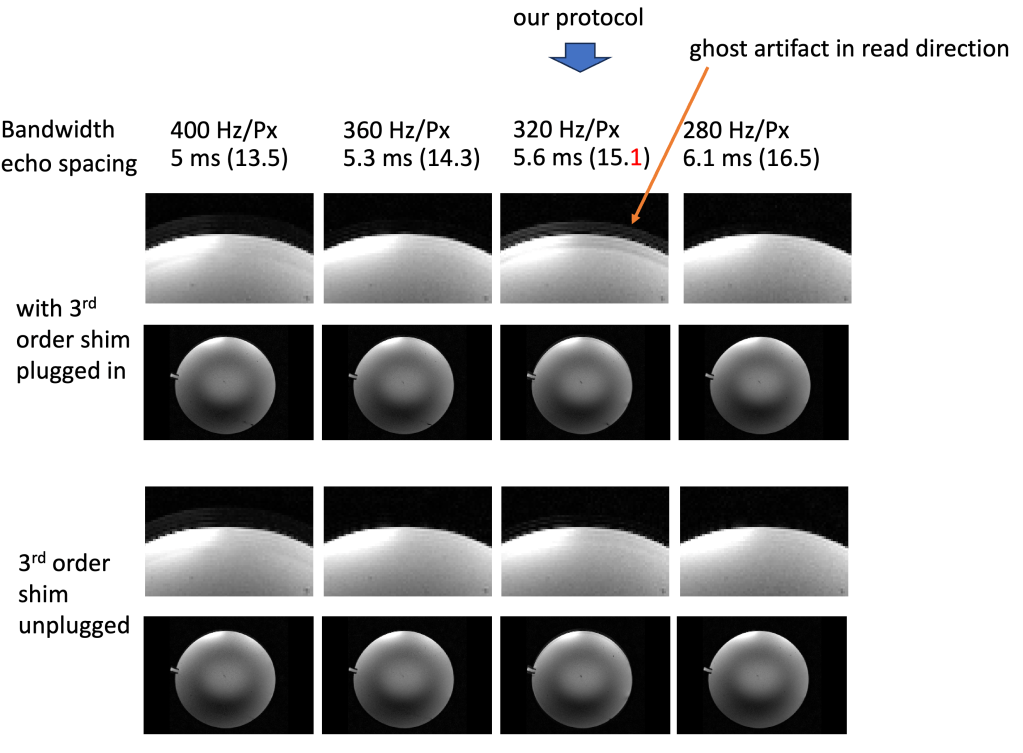
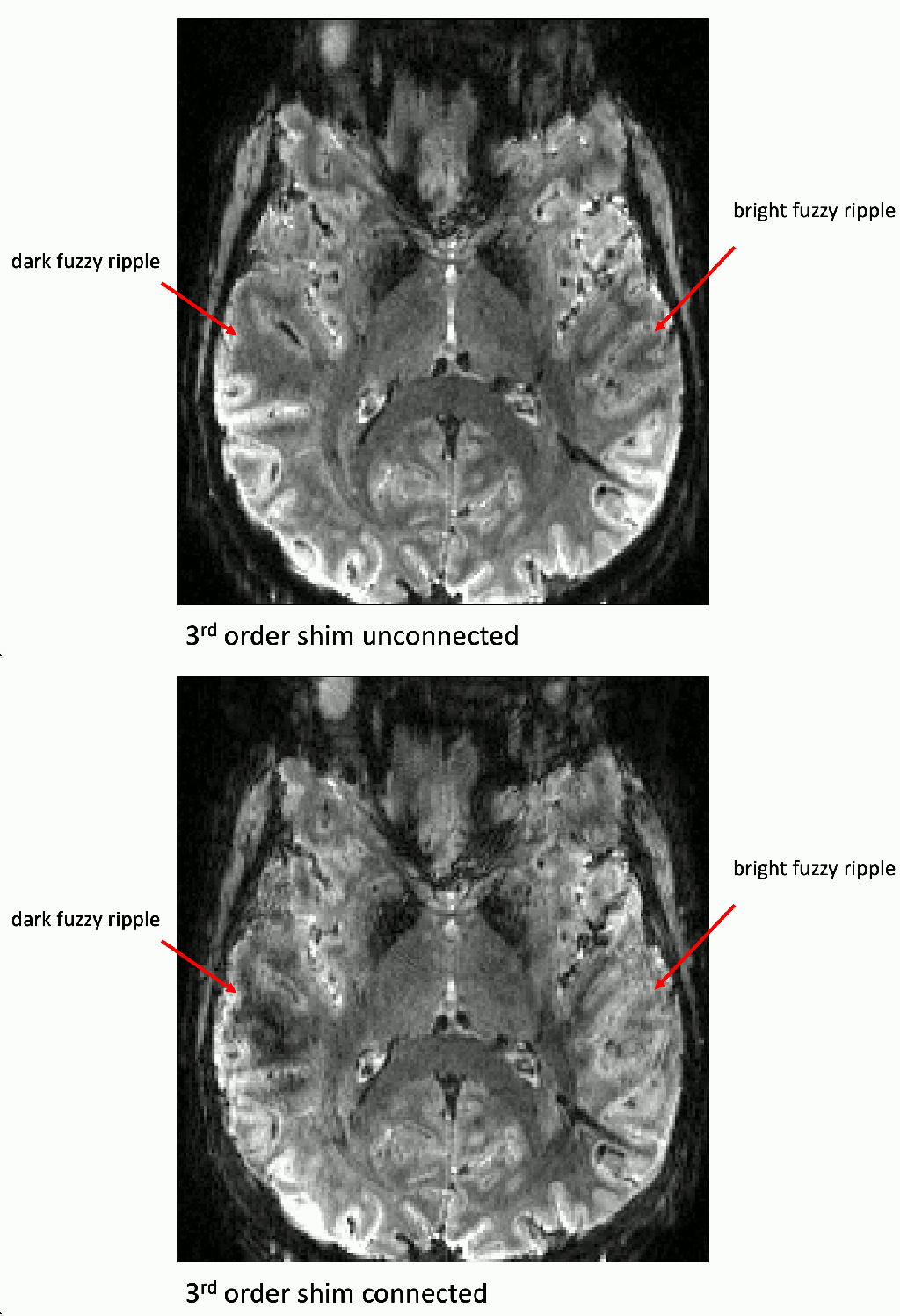
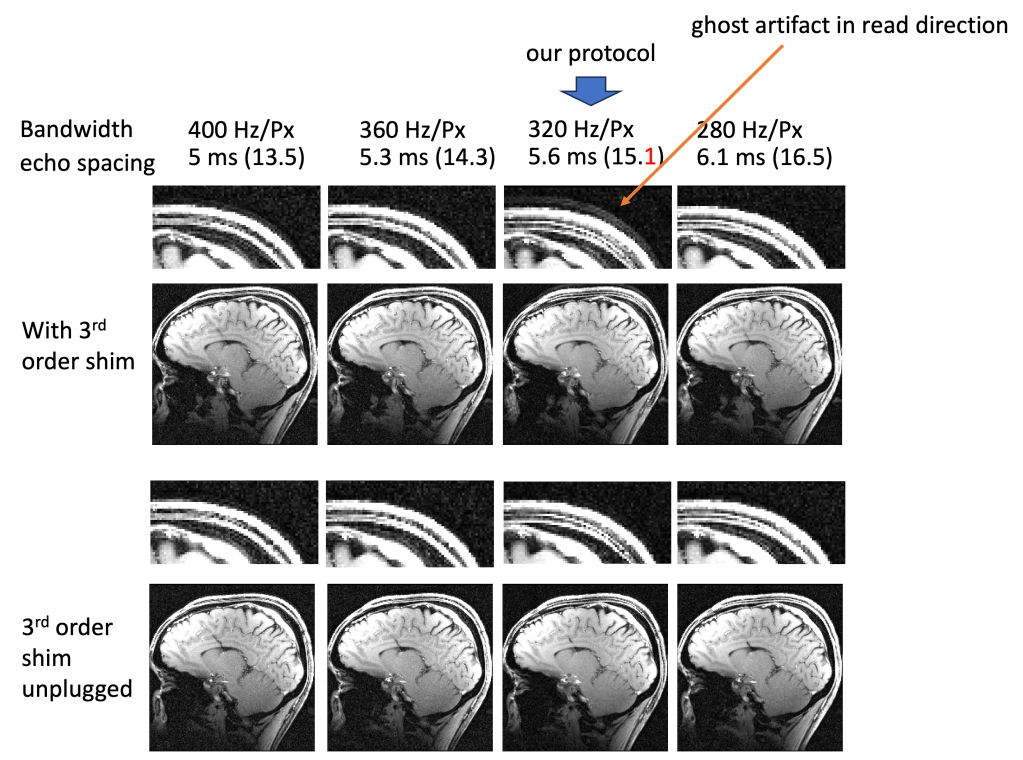
On Oct 13th 2023, Nicolas Boulant presented an intriguing source of MRI image artifacts at the CMRR high field meeting in Minnesota. He suggested that the 3rd-order shim can result in amplified gradient trajectory imperfections. In low bandwidth FLASH, this can manifest as faint ghosts in the read direction shifted by a few pixels. In EPI, on the other hand, these trajectory errors can result in fuzzy ripples (low spatial frequency ghosts and shadings, not edge ghosts).
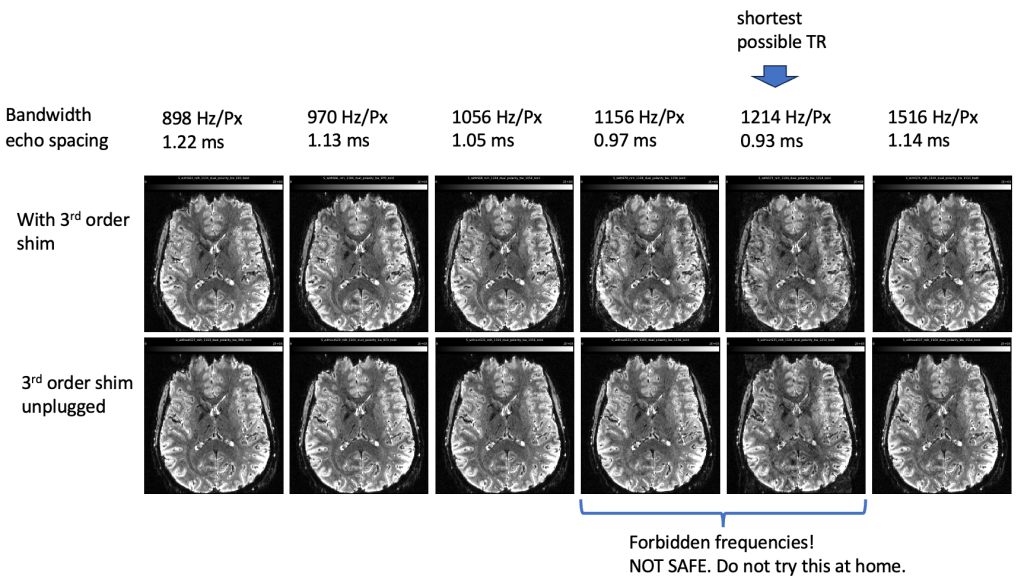
In a recent meta analysis of all openly available layer-fMRI datasets, I had found had that the fuzzy ripples are one of the main limits of high-quality layer-fMRI acquisition (see here) across vendors. So, I was curious whether the 3rd order shim might be partly related to this. In this blog post, I am describing my attempts to reproduce Nicola’s results and investigate the effect of the 3rd order shim on layer-fMRI protocols. I find that disconnecting the 3rd order shim can result in significantly better data quality. However, this finding is only visible for specific echo-spacings, which are either in the ‘forbidden frequencies’ or which have side bands in the forbidden frequencies.
This post does not imply that previous research was conducted sub-optimally. Since, it is common practice to optimize the EPI echo spacing in the piloting stage of each study, the frequencies with these artifacts are usually avoided anyway. Here, we confirm that this is a good practice.
Experimental setup
I looked at phantom data (four sessions) and human data (four sessions). Each acquisition was performed twice, with the 3rd order shim plugged in and with the 3rd order shim unplugged. I tested the SIEMENS product sequence TURBOFLASH, the CMRR-multiband 2D-EPI sequence, and the DZNE 3D-EPI sequence. Images are acquired across a spectrum of echo spacings. The complete protocol PDFs are available on Github. Experiments were performed on the 7T Terra with SC72, with the following forbidden frequencies: 339.5-394.4 Hz and 500-600 Hz and 950-1250 Hz, corresponding to bi-polar EPI echo spacings 0.41-0.52 ms and 0.83-0.99 ms and 1.27-1.47 ms.
Phantom results

Human results (participant 1)
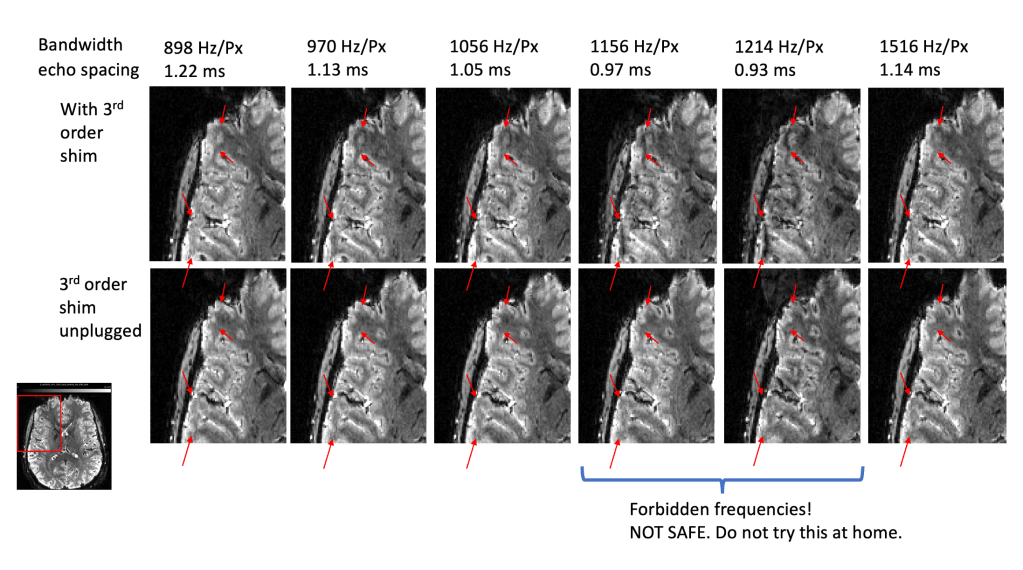
Human results (participant 2, axial results)
for the second participant, no forbidden frequencies were used. The residual effects are expected to solely arise from side bands of the main echo spacing, which arises from the fact that the trapezoidal EPI readout differs from sinusoidal readouts.
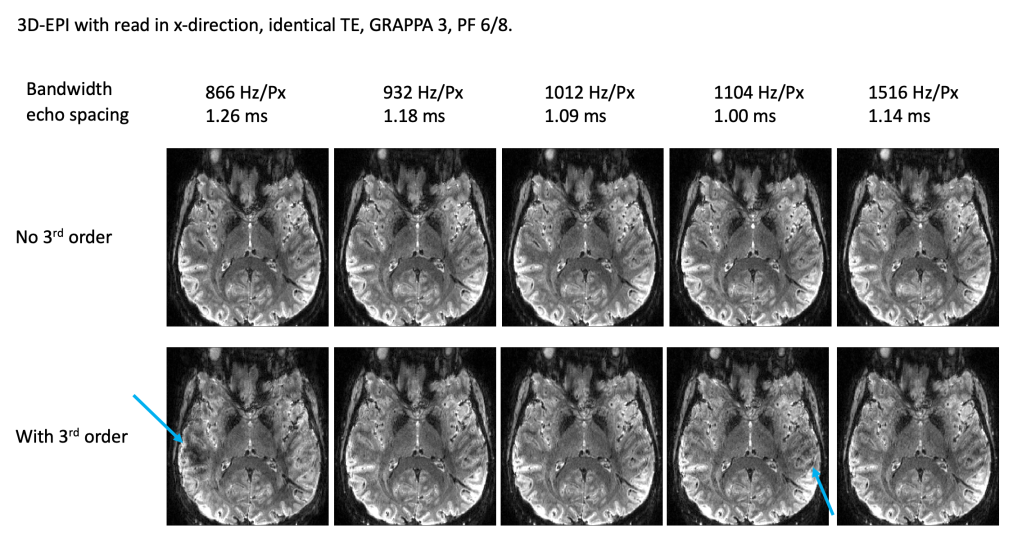
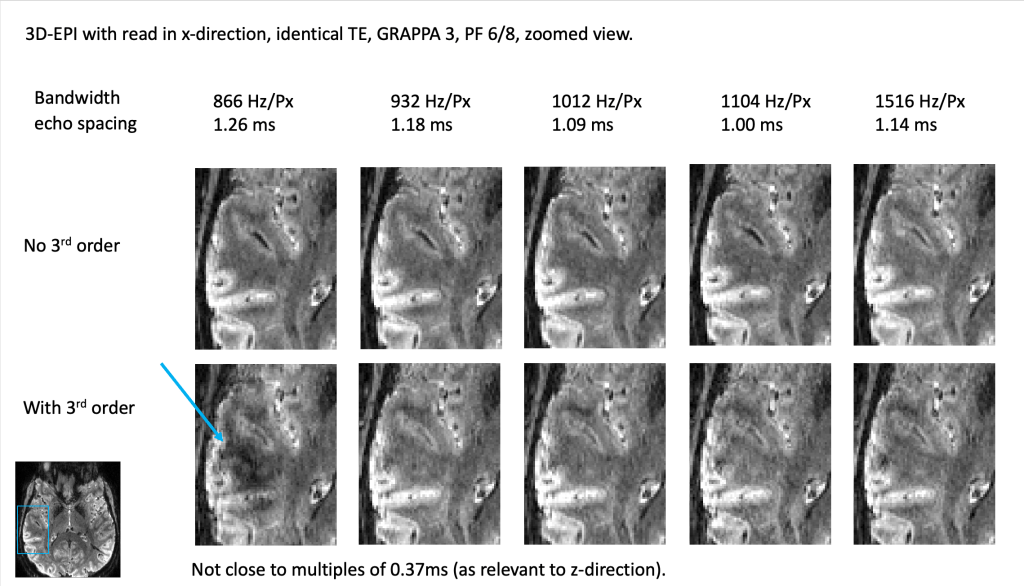
With the CMRR sequence, very similar echo spacings, exhibit fuzzy ripples.
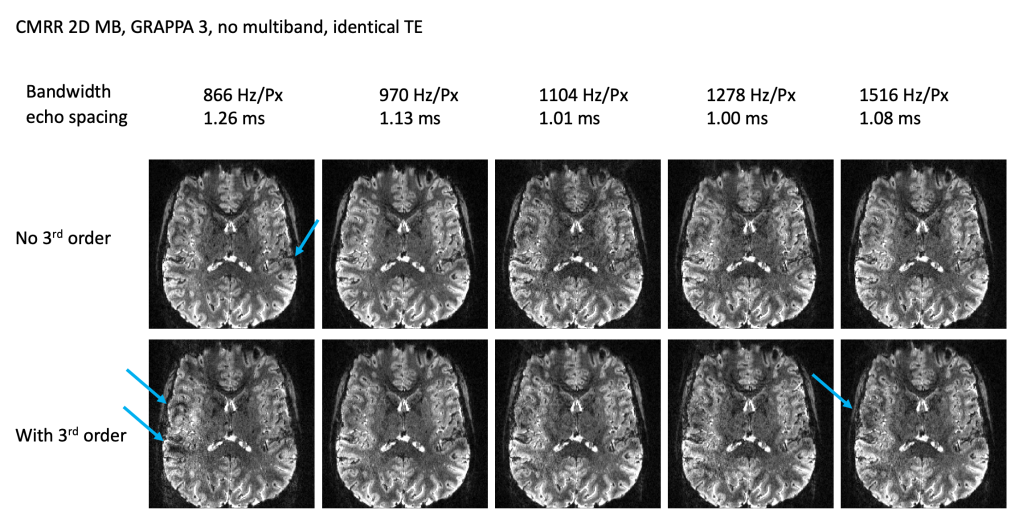
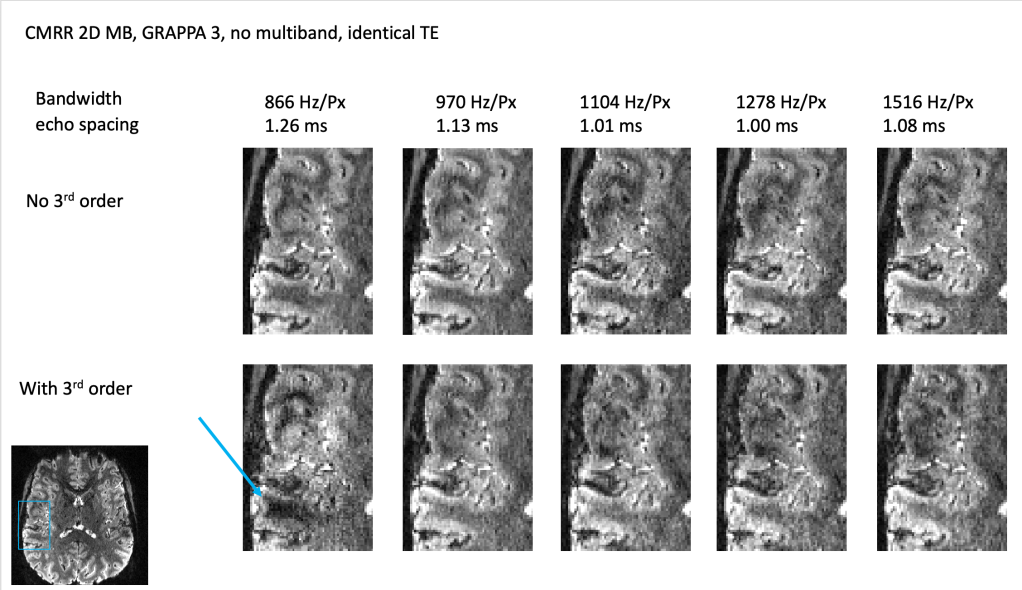
Human results (participant 2, sagittal results)
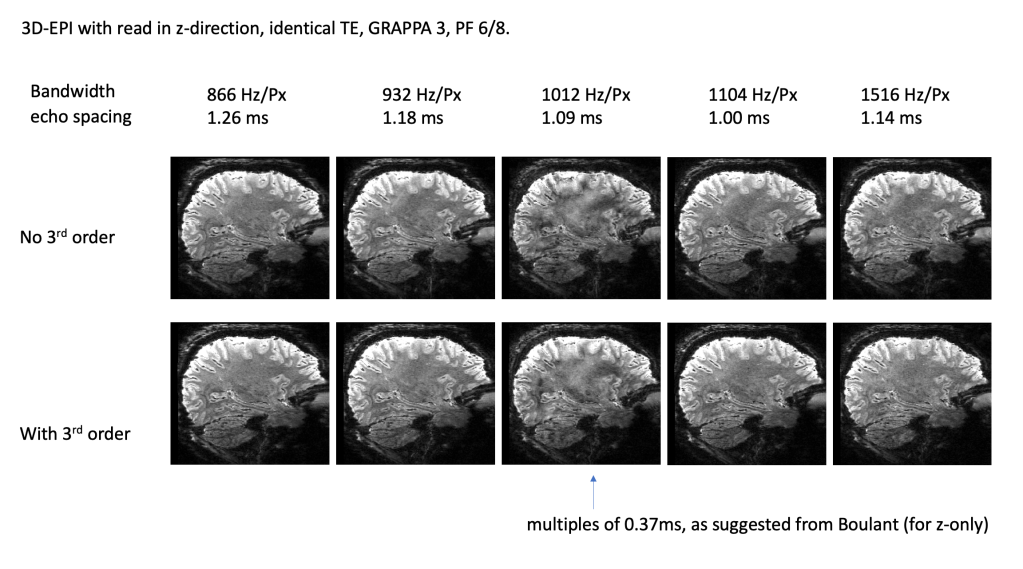
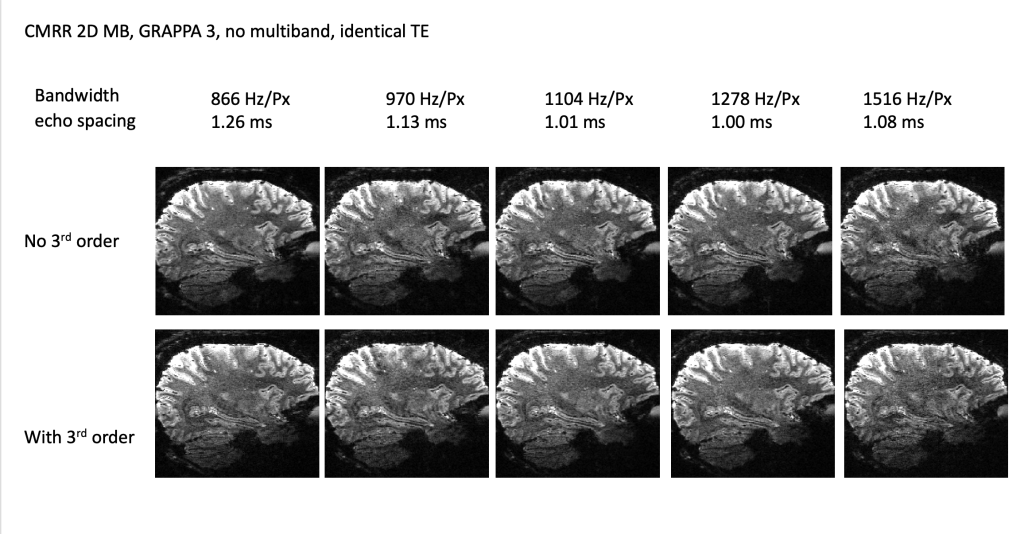
The same protocols as above were also tested in sagittal orientation.
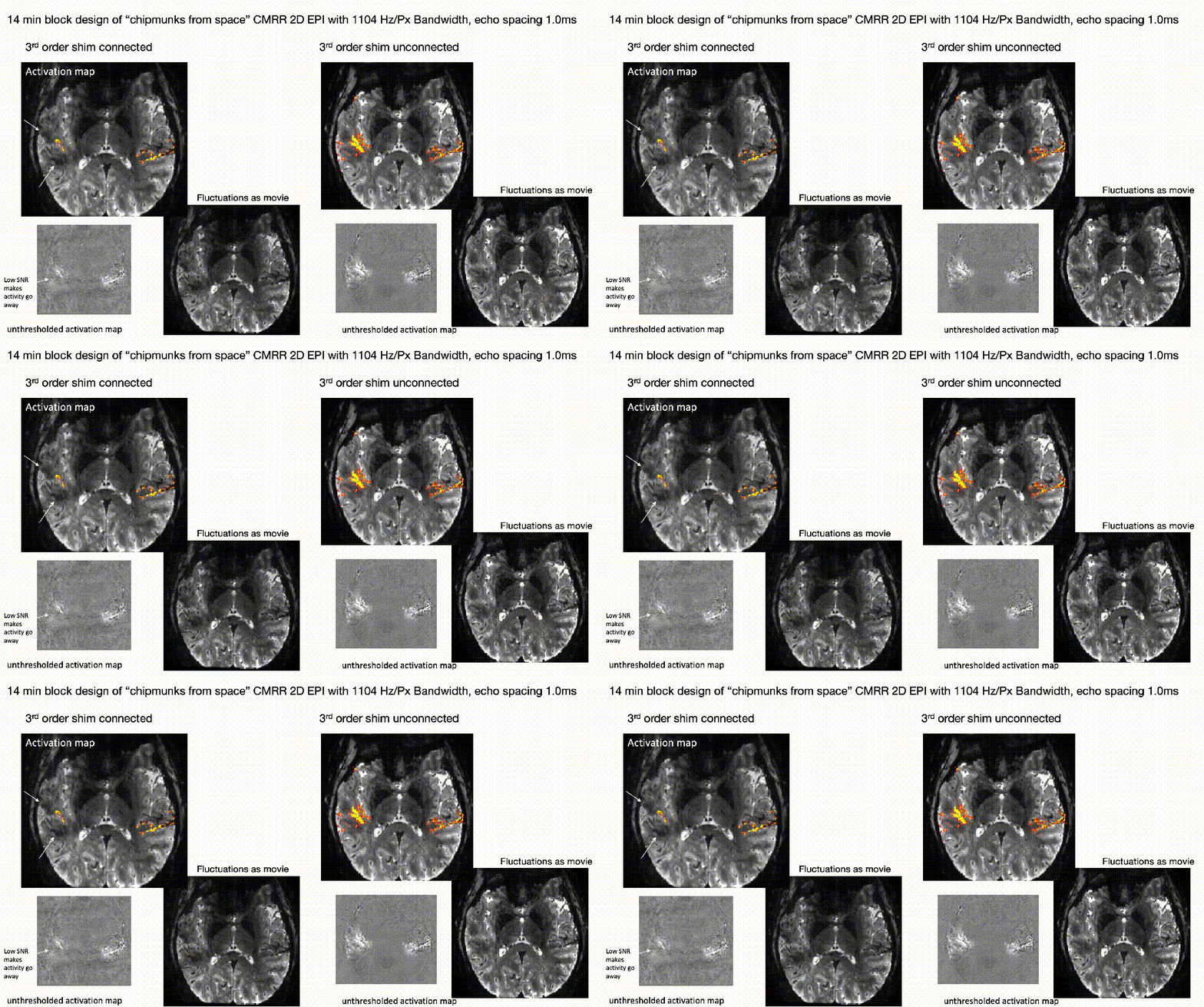
Functional results in two participants
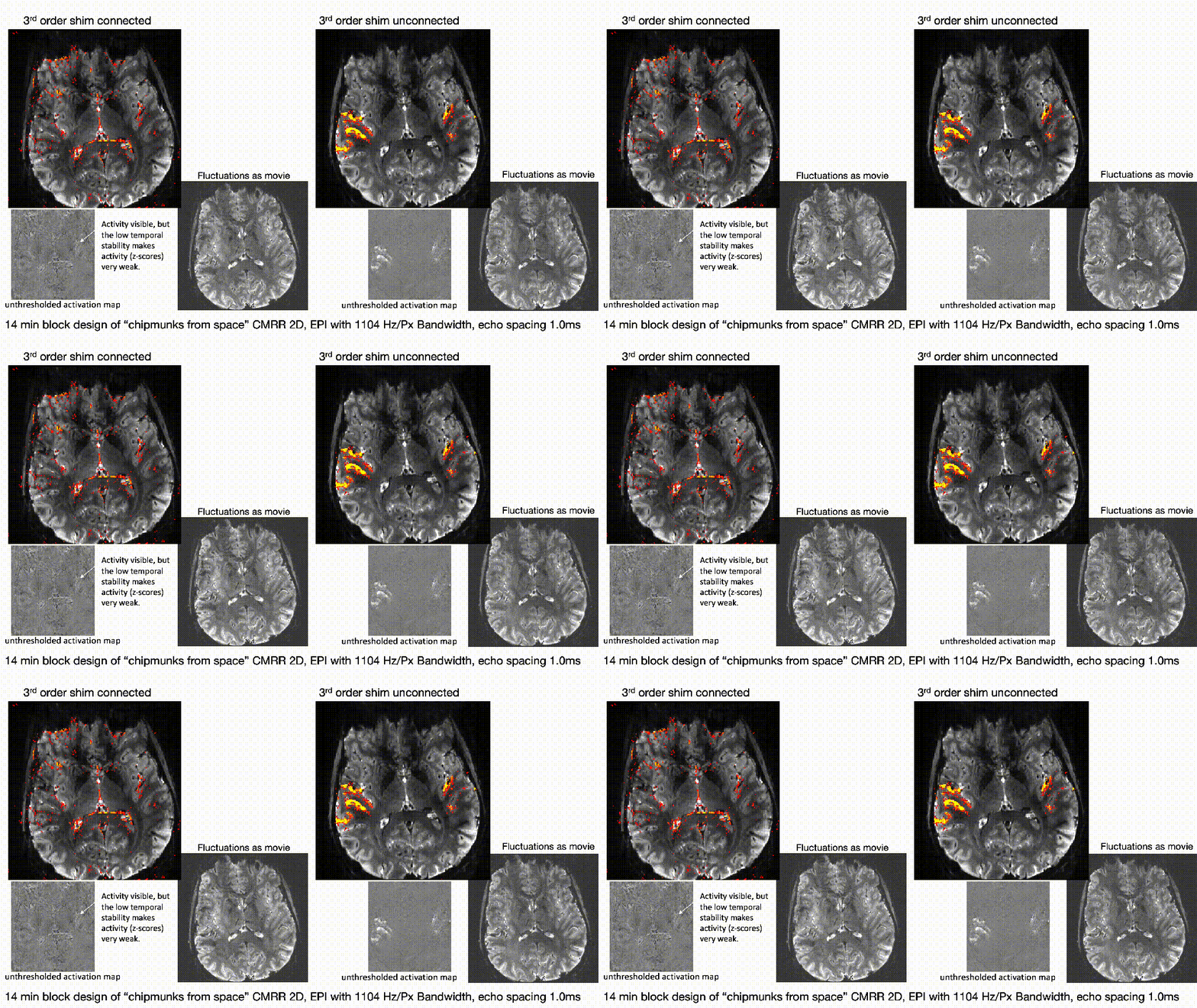
To participants were scanned with 2D-EPI, during a 14 min block-designed auditory stimulus. The purpose of this is to confirm that the artifacts seen above for static images affects the stability of the functional time courses.
Potential mechanisms why the 3rd order shim causes these issues
It is not clear to me what the mechanisms are exactly. The paper from Boulant et al. hypothesices that it’ related to magneto-mechanical interactions.
The 3rd order shim is a layer of the gradient coil between the primary inner layer and the outermost shielding layer. According to gradient builder Peter Diez at the Next Gen 7T opening workshop, the third order shims always share some symmetry with the gradients, and thus they have a stronger unwanted coupling.
The effect of the third order shim is independent of whether there is active or not (aplifyiers switched on or not). It does not matter if active current is flowing through them, the artifacts will remain visible. Even if the third order shim is completely powered down, but still connected to the RF shield of the room, the effect is the same. In order to reduce the effect, the cable needs to be unplugged.
Alternative approaches to mitigate fuzzy ripple artifacts
While the fuzzy ripples seem to be largely caused by eddy currents from the 3rd order shim, it might not need to be necessary to unplug them completely. Alternatively, it is possible to change the echo spacing to be far away from the temporal frequency where they are strongest (0.37ms according to Nicolas Boulant). E.g. increasing TE and TR by 30% makes the fuzzy ripples go away, with or without the 3rd order shim.
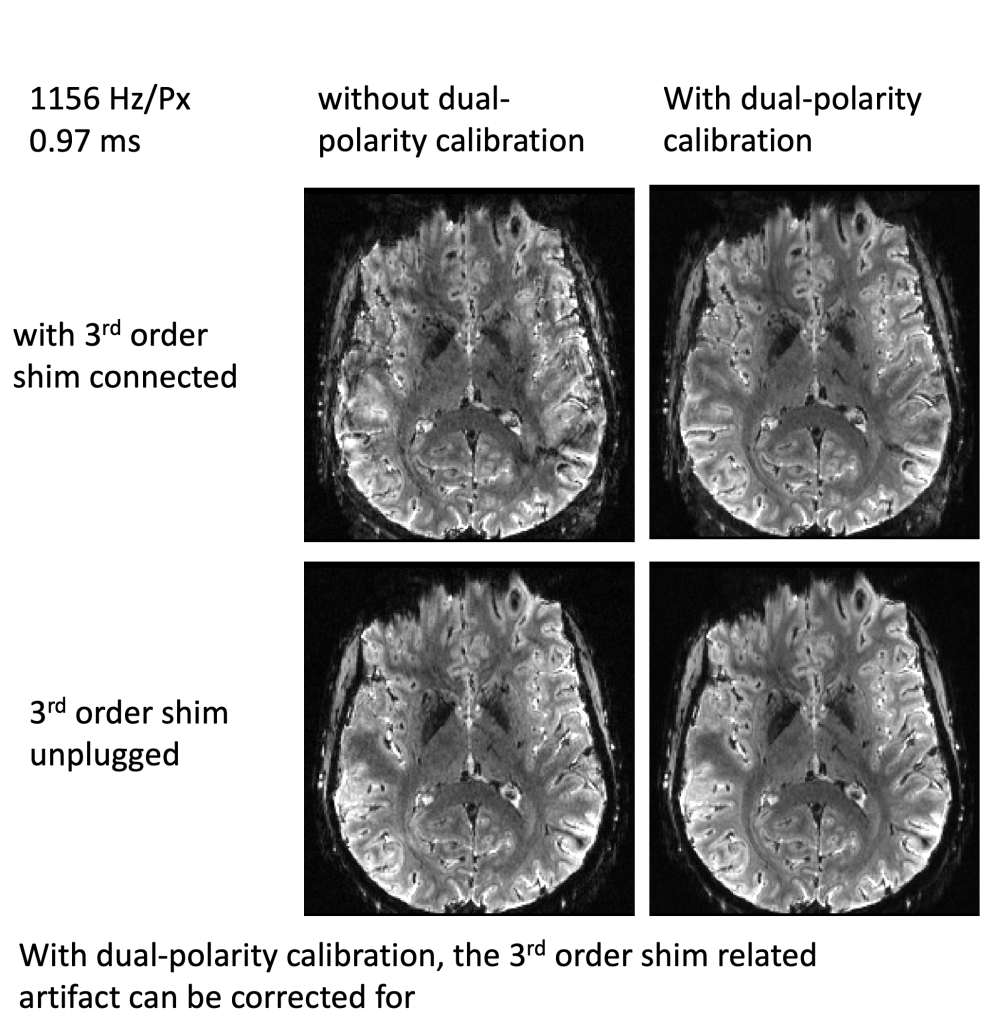
Alternatively, it’s also possible to calibrate for the respective gradient trajectory imperfections in the reconstruction pipeline by means of a dual polarity readout.
Contraindications
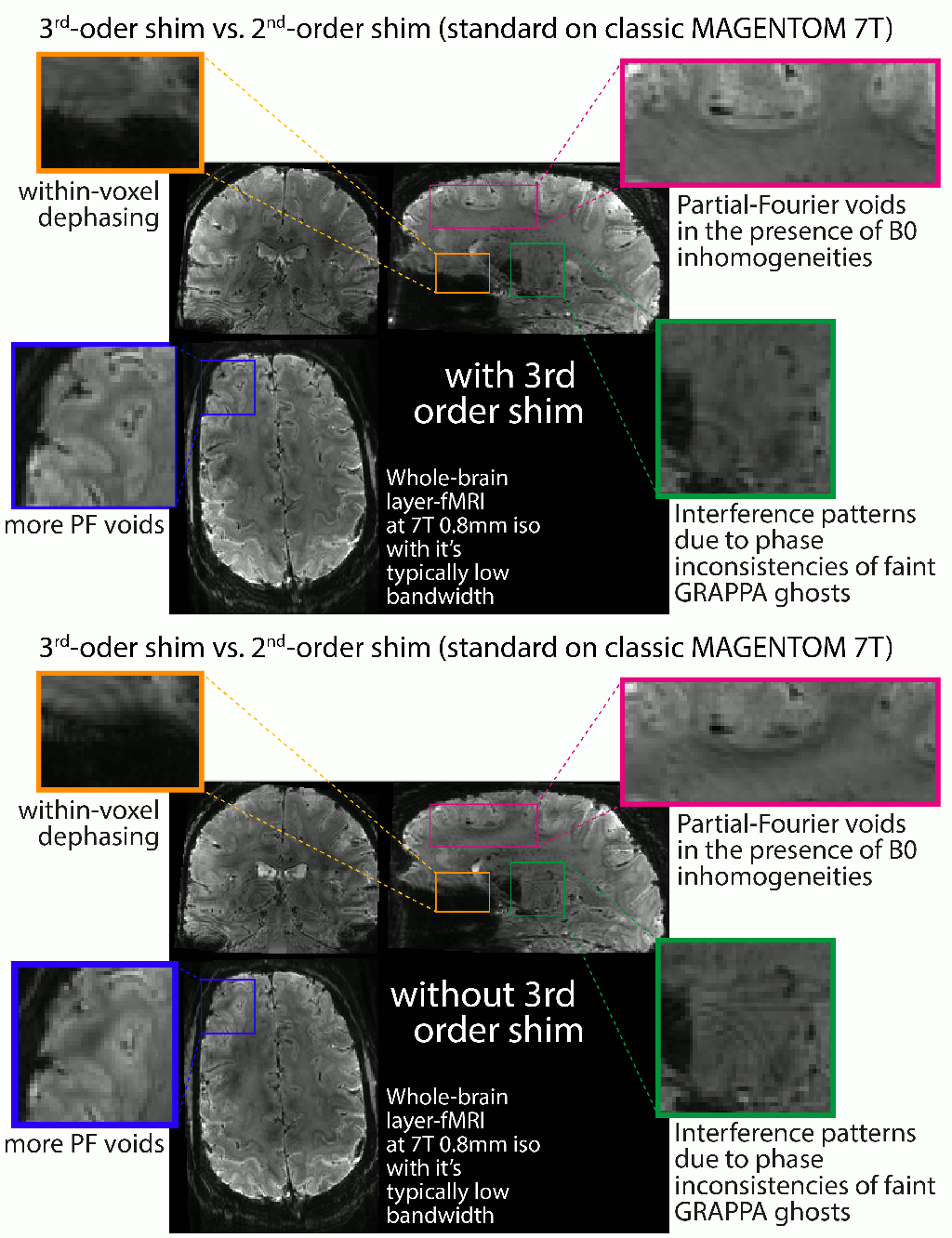
While the third order shim can cause the artifacts described above, for other bandwidths it has the potential to mitigate these very artifacts that are caused by other issues (e.g. of resonance effects). E.g. for very low bandwidth layer-fMRI protocols across large field of views, the second order shim alone cannot fully compensate off-resonance inhomogeneities as effective as the third order shim. This can then result in very similar artifacts. Thus, it’s not clear to me if it’s wise to permanently unplug the third order shim.
Process of how the 3rd order shim was unplugged.
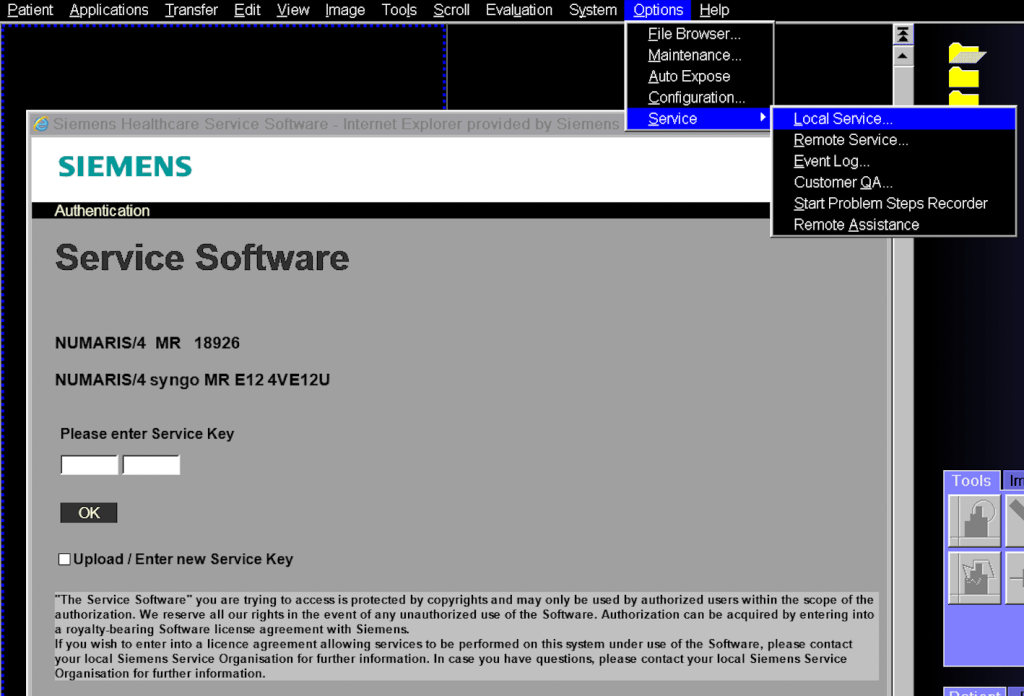
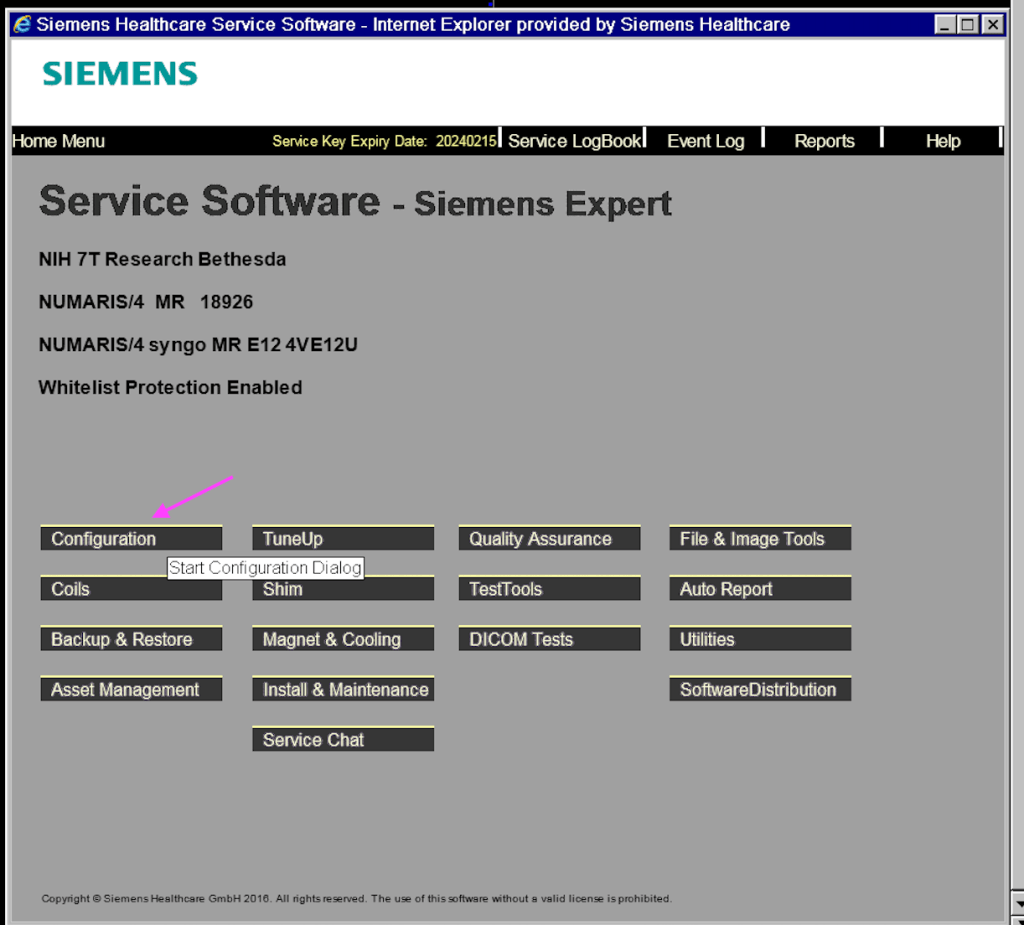


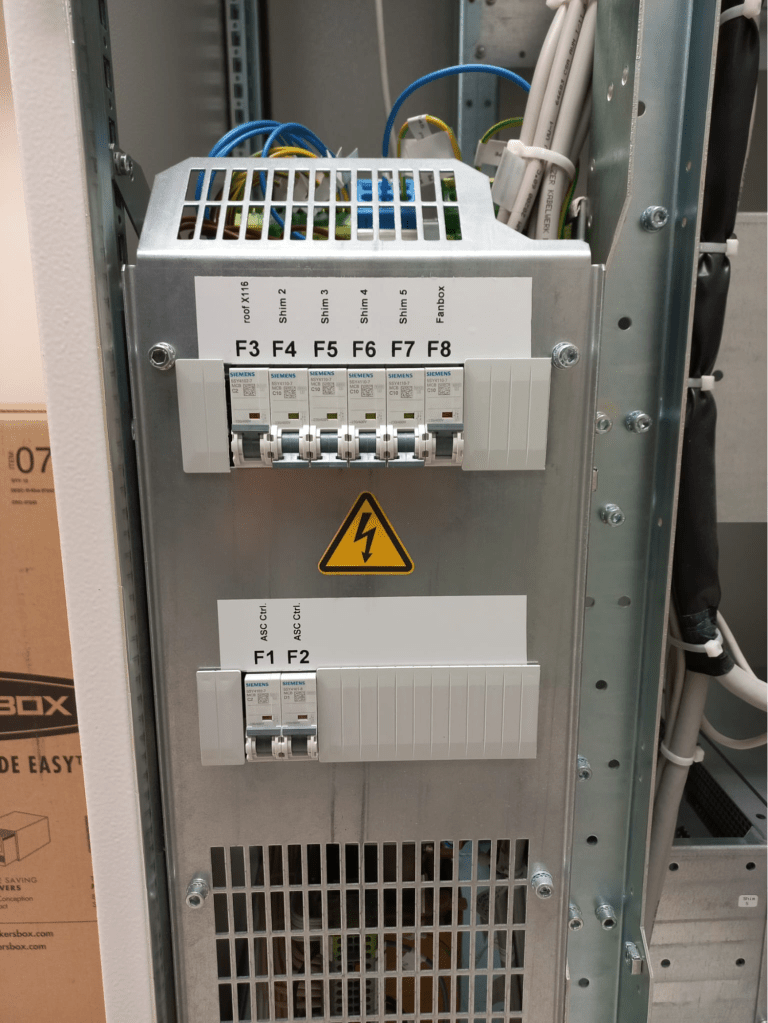
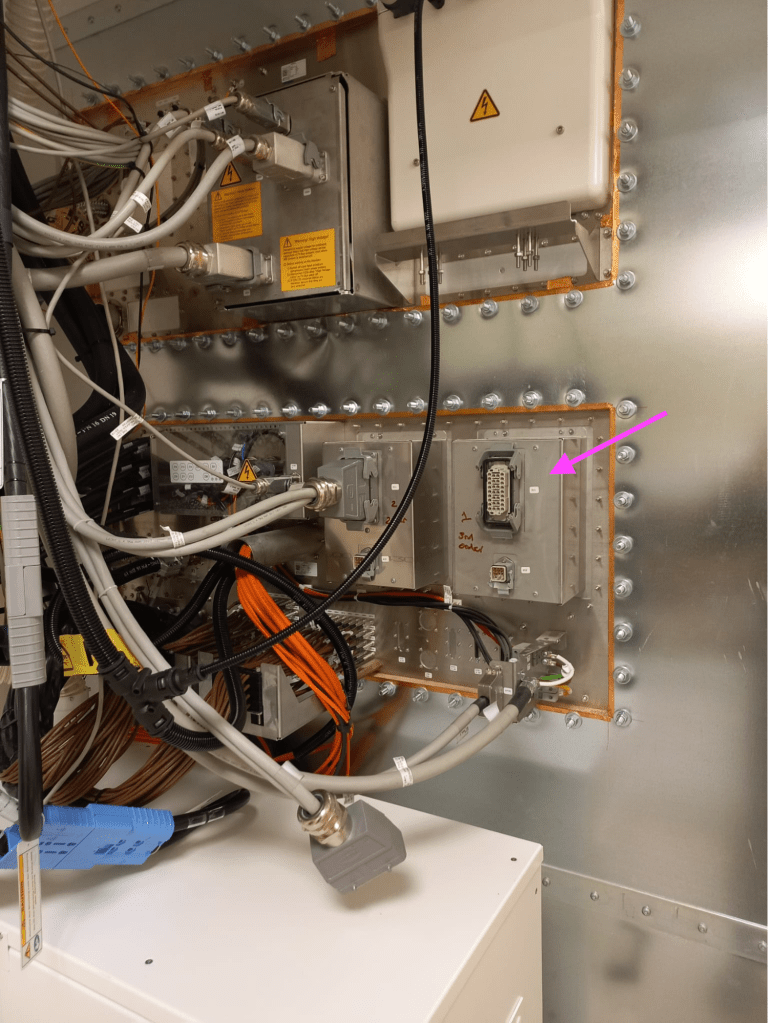
Process of how the 3rd order shim can be unplugged on Terra.X
At the Terra.X the restart needs to be done by the user them selves, it is no longer done automatically. The restart is much faster under XA. It only takes 5-6 minutes. Note that the local service key needs to have the right privileges. Dependent on how it it setup the conventional user: medadmin might not see the options of measurement configurations.
Switching third order shim off:
- change shim configuration setting to “standard” on host (in Administration Portal, see picture).
- on host “restart system”.
- listen to three knocks and start scanning.
- unplug 3rd order shim cable inside faraday cage.
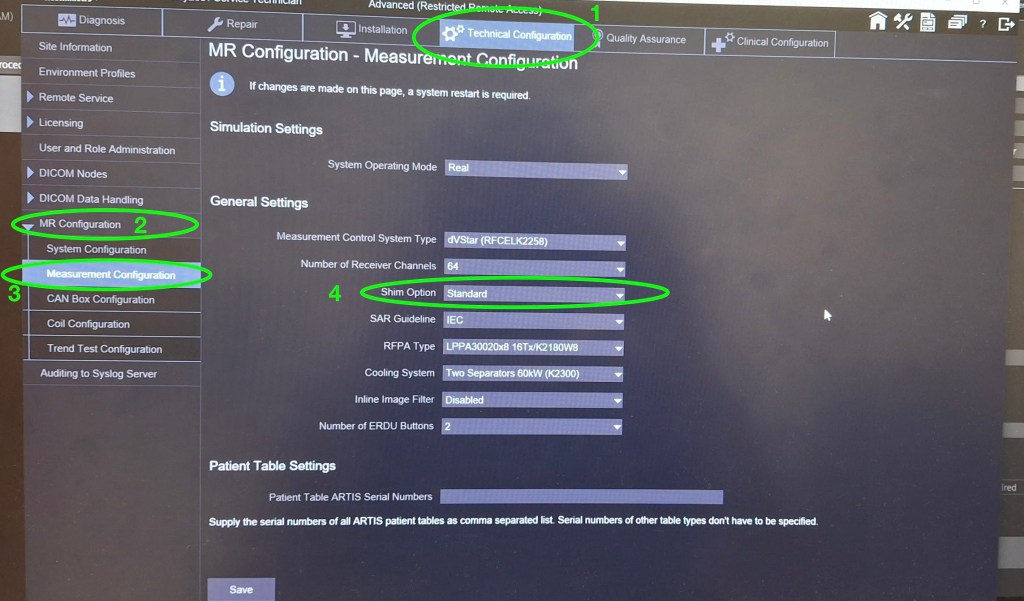
Switching it back on:
- connect shim cable
- change shim configuration setting to “advanced” on host (in Administration Portal).
- restart system
Acknowledgements
I thank Nicolas Boulant for discussions, for sharing his approach of disconnecting the third order shim and showing his results again personally on zoom. Ultimately, I could not use the same unplugging approach though, because of lacking SIEMENS passwords. I thank Kenny for performing the invivo scan with me. I want to thank the Healthineers Robin Heideman, Reinaldo Gabarron, Sunil Patil, and Bernd Stoeckel for discussions and for sharing their approaches of switching off the 3rd order shim. I thank Chris Wiggins for implementing, testing and sharing scripts to include and exclude the third order shim from the vendor 3D-shim tools.
Addendum
In the mean time, Nicola’s paper has become publicly available here.
 layer fMRI blog