
On February 8th 2024, we will host the 8th virtual layer-fMRI dinner. As usual, it’s free, just follow the link below.
The 6th layer-fMRI dinner will focus the relationship of layer-fMRI academia and industry. Layer-fMRI basic research and industry have different goals, yet they help and facilitate one another. Without each other, each of our lives would be harder.
The relationship between layer-fMRI and industry is close; closer than we might want to admit. Without the ability to ‘just buy’ a 7T scanner, ‘just download’ professional layer-fMRI visualization software, or ‘just execute’ good MR pulse sequences, layer-fMRI would be nearly impossible.
At the same time, industry benefits from layer-fMRI. Layer-fMRI has been a technology driver for many MRI technologies that are now routinely performed in clinical settings. Many big MRI innovations in recent decades have been driven by and firstly implemented for high resolution fMRI: 7T, SMS, advanced GRAPPA, fast gradients, advanced readout approaches, etc.
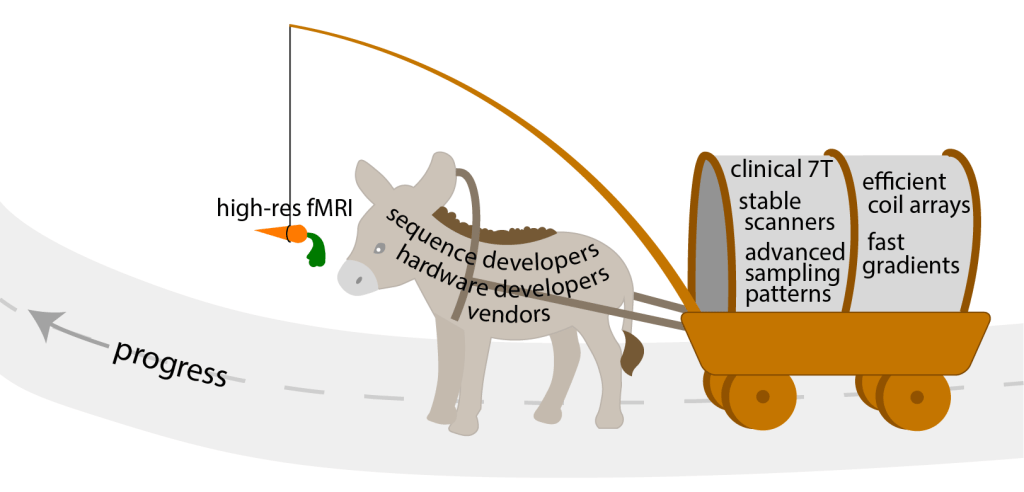
Taken from https://layerfmri.com/the-best-sequence/.
However, as layer-fMRI researchers, we are insatiable. We are never happy with what we get from industrial partners.

Taken from https://layerfmri.com/metaphors2/.
As important as this relationship is, we don’t have established communication channels. The big conferences (e.g. ISMRM) explicitly do not want us to talk about it because “there is a conflict of interest”. The scientific literature avoids this topic, as it is “not research”.
Consequently, many people in the layer-fMRI field have open questions:
- Is 7T sustainable? Does it make sense to invest my career in layer-fMRI at 7T, if the vendors might stop building 7T scanners in the future without a growing clinical market.
- Is it true that I can use industry collaborations to get easier access to grant money?
- Why are the industry folks not sharing all their material? I can improve it and they would benefit from this.
- What are the advantages and disadvantages of working in academia or industry?
For the 6th layer-fMRI dinner, we are excited to have three speakers talking about layer-fMRI and industry form various angles:
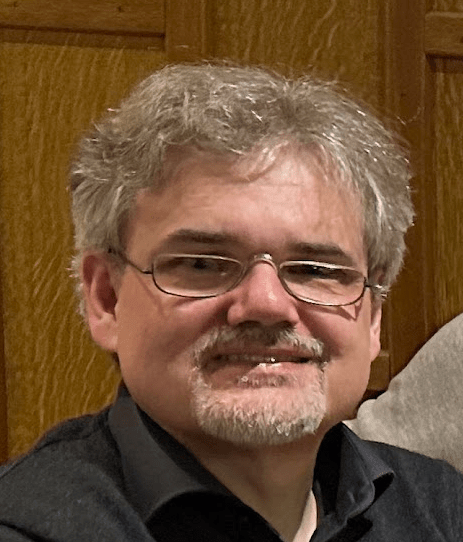
- Rainer Goebel is a Professor of the University of Maastricht, as well as the head of Brain Innovation B.V. – the company behind Brain Voyager. Rainer has focused much of his academic work on neuroscience application studies at mesoscale spatial resolutions and has invested parts of his industry work on user-friendly turn-key layer-fMRI processing. In his presentation, he will talk about layer-fMRI in both worlds. He will also talk about how he can use his company to support layer-fMRI development projects across time scales that are not possible within normal working conditions of PhD students.

- Robin Heidemann is the head of the UHF development group at Siemens Healthineers. Before joining SIEMENS full time, he had an academic career combining image acceleration with high resolution fMRI at 7T. In collaborations with academia, Robin and his UHF development group are developing, validating, and streamlining the usability of 7T scanners for research and clinical use. In his presentation, he will talk about the vendor perspective of high resolution fMRI. He will also talk about the Terra.X scanner; the latest 7T scanner from SIEMENS. Its just a matter of years until the Terra.X will become the workhorse for most modern layer-fMRI research.

- David Feinberg is a Professor at UC Berkeley and he is the head of Advanced MRI Technologies, LLC. His company and his academic research focus on MR pulse sequence innovation and development, particularly for high-resolution layer-fMRI. In recent years, he has led the next generation 7T project (aka the Feinbergatron). This scanner has been specifically designed for layer-fMRI and has become reality by means of industrial collaborations between academia and companies like SIEMENS and MR-coil tech.
Each presentation will be 15-20 min followed by a general discussion. The entire event will last for about 90 min (including discussion).
The meeting will be recorded and published on Youtube and embedded on this page on the same day Feb 8th, 2024.
Everyone is welcome. No registration required. Zoom link: https://nih.zoomgov.com/my/layerfmri.
| Berkeley PST | Chicago CST | New York EST | UK GMT | Berlin CET | Beijing CST | Tokyo Feb9th | Sydney Feb 9th |
| 7am | 9am | 10am | 3pm | 4pm | 11pm | 0am | 2am |
Diversity statement: The speakers of this layer-fMRI dinner are three white male senior group leaders from rich countries, which is not in line with the code of conduct to honor diversity within our field. The 6th layer-fMRI dinner is the first event that does not feature a woman speaker, despite the fact that women represent 15% of the field of layer-fMRI. This unfortunate lack of diversity comes from the limited number of people that have experience in both layer-fMRI and industry. Unfortunately, speaker invitations to potential women presenters had been declined. We are hopeful that the topic will be of interest, though. Industry-academia relationship is not something that is covered in conventional ‘same old lectures’.
 layer fMRI blog