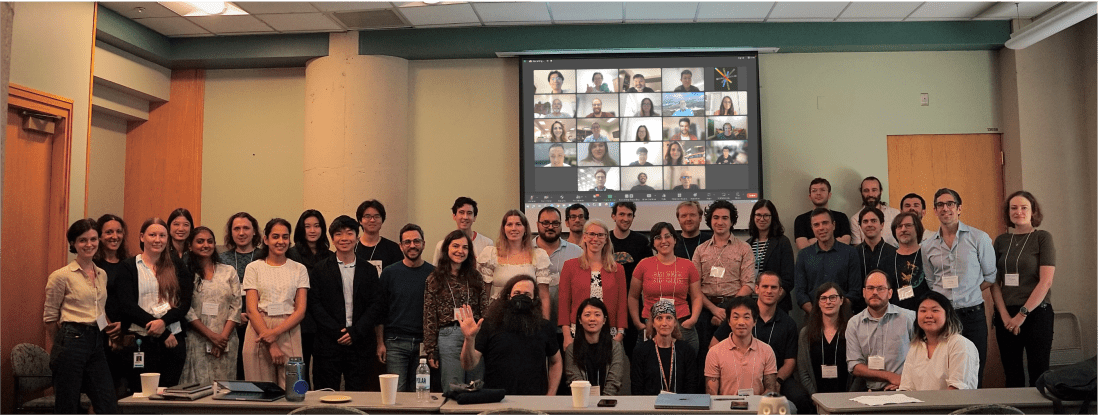
Video recordings of Laminar fMRI Course at Martinos Center 2023

October 2-5 2023 @ Martinos Center in Boston, MA 

The combination of ultra-high field (7 Tesla and above) imaging with increasingly sophisticated data analysis tools has led to a surge of research using functional MRI acquisitions to examine the behavior of individual cortical layers of the brain. This course will focus on teaching the acquisition and analysis tools needed to contribute to this research.    

Content: four days of hands-on training on laminar fMRI
day 1: introduction to laminar fMRI & basic data acquisition
day 2: data preprocessing and analysis
day 3: interpretation and modeling
day 4: advanced applications and future directions

Continue reading “Video recordings of Laminar fMRI Course at Martinos Center 2023”

OHBM 2024 Brainhack: Hack your RF coil

This hackathon project is part of the series, Hack your Scanner, following contributions of previous years. 2022 VASO mosaic, 2021 visual exporting scanner data with QR Modem, 2020 viewing data with ASCII art on MARS with LN_INFO. This year is about hacking your RF-coil.


Continue reading “OHBM 2024 Brainhack: Hack your RF coil”

NORDIC denoising on VASO data

Authors: Lasse Knudsen, Luca Vizioli, Federico De Martino, Lonike Faes, Dan Handwerker, Renzo Huber

This post describes the usage, capabilities and challenges of NORDIC PCA denoising on VASO data. A video presentation of this project can be found here: https://youtu.be/bbGKMTWVrJY.

Continue reading “NORDIC denoising on VASO data”

Equi-voluming: The Anakin Skywalker of layering algorithms

Authors: Renzo Huber and Faruk Gulban

When you want to analyze functional magnetic resonance imaging (fMRI) signals across cortical depths, you need to know which voxel overlaps with which cortical depth. The relative cortical depth of each voxel is calculated based on the geometry of the proximal cortical gray matter boundaries. One of these boundaries is the inner gray matter boundary which often faces the white matter and the other boundary is the outer gray matter boundary which often faces the cerebrospinal fluid. Once the cortical depth of each voxel is calculated based on the cortical gray matter geometry, corresponding layers can be assigned to cortical depths based on several principles.

One of the fundamental principles used for “assigning layers to cortical depths” (aka layering, layerification) is the equi-volume principle. This layering principle was proposed by Bok in 1929, where he tries to subdivide the cortex across little layer-chunks that have the same volume. I.e. gyri and sulci will exhibit any given layer at a different cortical depth, dependent on the cortical folding and volume sizes (see figure below).

With respect to applying equi-volume principle in layer-fMRI, the equi-volume layering has gone through quite a story. A plot with many parallels to Anakin Skywalker.

In this blog, the equi-volume layering approach is evaluated. Furthermore, it is demonstrated how to use it in LAYNII software.

Continue reading “Equi-voluming: The Anakin Skywalker of layering algorithms”

Referral to description of layerification algorithm in LN2_LAYERS

How can one assign layers to discrete voxels? Is it possible to perform topographical fMRI analyses across layers and columns directly in the original voxel space that raw data from the scanner come in? 

Continue reading “Referral to description of layerification algorithm in LN2_LAYERS”

layer-fMRI Webinar MBIC 2020

Title: High resolution fMRI: An introductory course for data acquisition and analysis challenges.

Support: This lecture series is finanzially supported by the FPN-MBIC-school. The session on sequences and sequence artifacts is supported (in kind) by the York-Maastricht-partnership grant. Faruk Omer Gulban works for Brain Innovation.

Coordinators: Laurentius (Renzo) Huber & Omer Faruk Gulban, Cognitive Neuroscience Department

Email: renzohuber@gmail.com or faruk.gulban@maastrichtuniversity.nl

Dates: 7, 14, 21, 28 July 2020 (4 sessions in total), 3pm to 4:30pm.

Video Conference Zoom link (note that these sessions may be recorded): https://maastrichtuniversity.zoom.us/meeting/register/tJAvcu-qpj8sHNVD71Vcu95et-R14QKRs22T

Continue reading “layer-fMRI Webinar MBIC 2020”

Layer-fMRI VASO worldwide

This blog post gives an overview of the scientific network of researchers that are using the VASO (vascular space occupancy) for applications in layer-fMRI. I tried to give an overview of all layer-fMRI VASO papers published so far and provide a map of all layer-fMRI VASO labs around the globe. Continue reading “Layer-fMRI VASO worldwide”

‘layer fMRI’, ‘sub-millimeter fMRI’, ‘mesoscopic fMRI’, or ‘cortical depth dependent fMRI’…. Which term should I use?

What’s the best name of our field and what’s the best attributing term for our data? There are many competing options: “Layer fMRI”, “mesoscopic fMRI”, “sub-millimeter fMRI”, “ultra-high resolution fMRI”, “laminar fMRI”, “cortical depth-dependent fMRI”. They differ with respect to how flashy they are, how scientifically appropriate they are, and how popular they are.

In this blog post, I want to review which ones are the most popular ones in the field and also share some thoughts on my favourite candidates.

Edits on March 3rd 2019 with contributions and clarifications taken from Kamil Uludağ, Sri Kashyap and  Faruk Gulban.

Continue reading “‘layer fMRI’, ‘sub-millimeter fMRI’, ‘mesoscopic fMRI’, or ‘cortical depth dependent fMRI’…. Which term should I use?”