3D-printing nii data

In this blog post, I want to write about pipelines on how to prepare Nifti-brain data and make them printable by a 3D-printer.

Two pipelines are shown. One pipeline describes the 3D-printing the cortical folding structure that is estimated with Freesurfer and subsequently corrected with Meshlab. And another pipeline describes how you can 3D-print any binary nii-volume by using the AFNI-program IsoSurface and correct the output with netfabb.  Continue reading “3D-printing nii data”

How to convert any paper figure into a layer-profile

Often we would like to normalize depth-dependent fMRI signals and assign it to specific cytoarchitectonially defined cortical layers. However, we often only have access to cytoarchitectonial histology data in the form to figures in papers. But since we only have the web-view or the PDF available, we cannot easily extract those data as a layer-profile. Since most layering tools are designed for nii data only, paper figures (e.g. jpg or GNP) are not straight-forwardly transformed to layer profiles.

In this blob post, I describe a set of steps on how to convert any paper figure into a nii-file that allows the extraction of layer profiles.

Continue reading “How to convert any paper figure into a layer-profile”

2018 layer-fMRI meeting as part of the ISMRM study group ‘current issues in brain function’

Meeting minutes of Study group on brain functions business meeting:

15:30-16:30 in W07, June 21st, 2018, ISMRM, Paris:

Chunlei Liu presents the talk: “Ultra-high resolution fMRI – from hardware to pulse sequences to the human brain – and vice-versa. A 7T BRAIN Initiative Project” per pro David Feinberg.

In the subsequent Q/A period it is discussed that the current gradient design will be “asymmetric” and that the target parallel-imaging acceleration factor will be 20-30.

Past Chair Essa Yacoub presents the study group statistics:

There are many more trainees than full members.

Natalia Petridou presents the Trainee abstract awards:

  • #1 Adam Yamamoto for the abstract entitled: Intra-operative acquisition of sensorimotor fMRI during glioma resection: evaluation of feasibility and clinical applicability.
  • #2 Domenic Cerri for the abstract entitles: Mechanisms underlying negative fMRI response in the striatum. Since Dominic could not make it, he sent one of his collogues to receive the price for him.
  • #3 Yi-Tien Li for the abstract entitled: Inter-Regional BOLD Latency after Vascular Reactivity Calibration is Correlated to Reaction Time.

Renzo Huber presents the results of the survey among the study group members “Biggest challenges of high-resolution fMRI”. The slides can be downloaded here: https://doi.org/10.7490/f1000research.1115658.1

The attendees of the business meeting commented on the biggest challenges of high-resolution fMRI and the issues that could be discussed in a future virtual study group meeting.

·   Unknown (to me) senior study group member: At very high resolutions, the elastography of the brain might become a limit of submillimeter fMRI. This comment might be related to the Tweet from NIH Director Francis Collins that went viral on social media earlier that day: https://twitter.com/NIHDirector/status/1009793641550893056 (with amplified motion).

·   Ravi Menon: Motion is a big limitation of sub-millimeter fMRI.

·   Cheryl Olman: Every person/group uses a different analysis pipeline. It would be helpful to have a synthetic standard dataset that is open to everyone. Every person could play around with it and test the quality of various evaluation pipelines.

·   Hanzhang Lu: The virtual study group meeting would lose the interest of many study group members if the focus is only of 7T imaging. It would be helpful to also discuss the spatial specificity limitations at 3T too.

·   Shella Keilholz: Since there are so many trainee members, they should mention what they need.

·   Olivia Stanley (“encouraged” from Ravi Menon):

  1. Trainees want to know what segmentation tools are out there and how to use them.
  2. Trainees want more information on registration methods.
  3. Trainees would benefit from a tutorial on how to share code and how to use shared code.

·   Ravi Menon: So many people are sharing their code on various platforms. It would be helpful to have an online repository of repositories.

·   Essa Yacoub: It will be hard to standardize analysis pipelines because the data and the acquisition hardware is not standardized.

·   Trainee member (not known to me): The analysis of sub-millimeter fMRI takes a lot of computational recourses. Trainees can be limited by this.

·   Nikolaus Weiskopf: The image reconstruction can be a black box. It is not straight-forward to share pipelines of the Image reconstruction.

·   Nikolaus Weiskopf: Data-sharing becomes more difficult in the EU because of increasingly stricter privacy protection regulations.

·   Natalia Petridou: Data sharing is increasingly encouraged from the funding agencies and the journals.

·   James Pekar: The field of sub-millimeter fMRI stands on the shoulder of decades of preceding work from volunteers and people with passion. This study group can help todays volunteers and people with passion to increase their visibility.

Documentation of Installing an IDEA VirtualBox for VE11 from OVA

This post documents the installation of an IDEA VE11 virtual box on a mac as done on May 14th 2018

Big thanks to Andy for figuring out how this works

Prerequisites

  • Here I start with a already built images of IDEA on windows vista and mars on Ubuntu. the images from FMRIF can be taken from erbium.nimh.nih.gov:/fmrif/projects/SiemensIdea/virtual_machines/OVF/): IDEA_ve11c-mars.ova and IDEA_ve11c+vd13d+vd13a.ova
  • Virtual box software can be downloaded here.

Continue reading “Documentation of Installing an IDEA VirtualBox for VE11 from OVA”

EPI phase correction algorithms

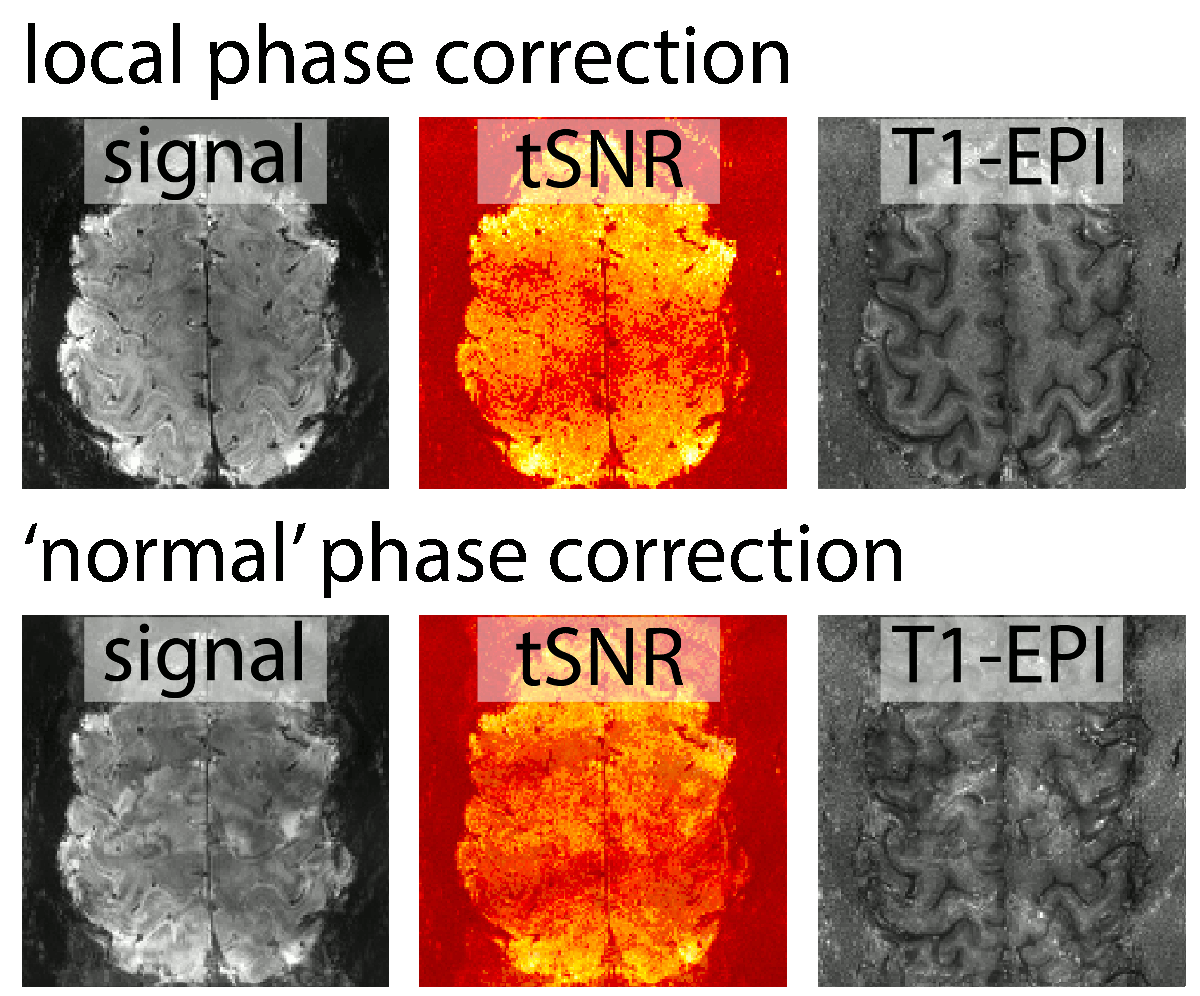
At high resolution EPI, the gradients are pushed to their limits and the ramp sampling ratio is particularly large. This means that the ghosting is increased and the Nyquist ghost correction is getting more important. In this post, I describe how to change the Nyquist ghost correction algorithm.

Phase_correction.gif
The high ramp sampling ratio in high-resolution EPI results in larger ghosts. Changing the correction algorithm from “normal” to “local” can help a lot.

Continue reading “EPI phase correction algorithms”

SS-SI VASO pitfalls in visual cortex

image125.gif
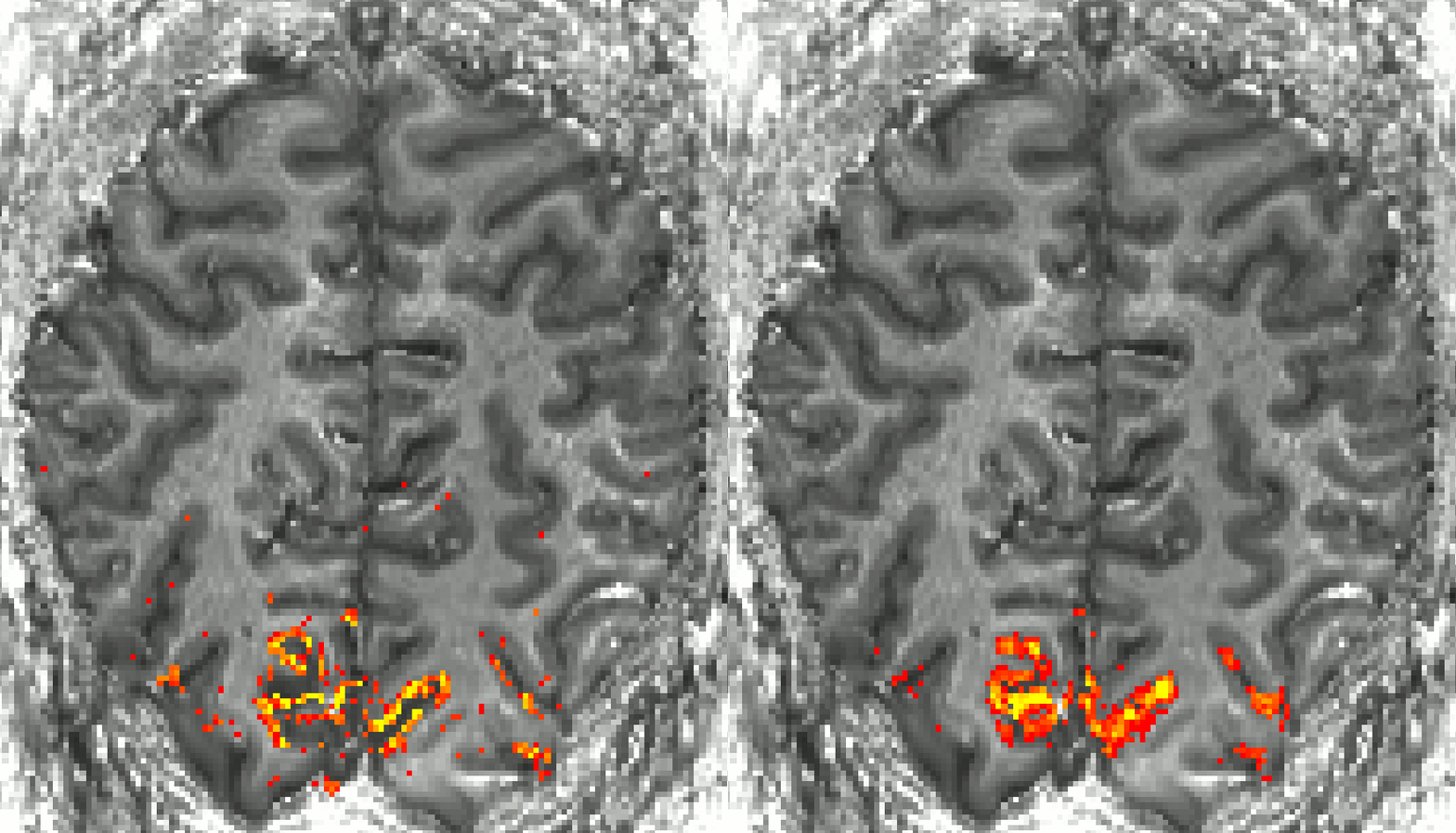
Activation maps for BOLD and VASO. At about 0.8 mm resolution, one starts to see that VASO is less sensitive to large draining veins.

With respect to high-resolution VASO application, visual cortex is very unique. I found it to be a challenging area. However, because of its high demand, I have been working on is with multiple collaborators. The most important pitfalls of SS-SI VASO in visual cortex that I came across in these collaborations are discussed below.

The take home message tat I learned from manny experiments is:

  1. Use axial slices with the phase encoding direction A>>P.
  2. Watch out for negative voxels.
  3. Invest a lot of effort in optimizing GRAPPA parameters, its worth it.

Continue reading “SS-SI VASO pitfalls in visual cortex”

Unwanted spatial blurring during resampling

In layer-fMRI, we spend so much time and effort to achieve high spatial resolutions and small voxel sizes during the acquisition. However, during the evaluation pipeline much of this spatial resolution can be lost during multiple resampling steps.

In this post, I want to discuss sources of signal blurring during spatial resampling steps and potential strategies to account for them.

Continue reading “Unwanted spatial blurring during resampling”

Partial-Fourier imaging at High Resolutions

This blog post discusses the resolution loss when applying partial-Fourier imaging in GE-EPI in the presence of strong T2*-decay.

I found that that when I was aiming for high-resolutions, it is beneficial to refrain from the application of partial Fourier (PF) imaging as much as possible. For the long readout durations at high-resolutions and the fast T2/T2*-decay at high field strengths results in even stronger blurring of partial-Fourier.

Continue reading “Partial-Fourier imaging at High Resolutions”

Smoothing within layers

Smoothing within layers can be advantageous for multiple reasons:

  • Increasing the CNR without loosing spatial information across cortical depths.
  • Visualization of striping pattern across columnar structures.
  • Avoiding leakage of physiological noise from CSF space into GM tissue.

image88.gif Continue reading “Smoothing within layers”

Finding ROI of the double layers in M1

In this post I want to describe the guidelines that helped me to find the right spot of primary motor cortex (M1) that has a double-layer pattern during a conventional finger tapping task.

The motor cortex is an excellent model system to debug-layer fMRI methodology for multiple reasons:

  1. It has a consistent folding pattern across people.
  2. Its folding pattern is convoluted across one axis only. Hence, it is possible to use thicker slices with higher in-plane resolution.
  3. With 4mm, its is the thickest part of the cortex compared to all other areas. Hence, layer analysis can be done even with 1.2 mm voxels.
  4. It has an expected double layer structure, with two separate peaks. The separability of the peaks can be used as a measure of functional specificity.
  5. It is very close to the RF-receive coils and has high tSNR.
  6. It is easy to shim.

One tricky part, however, is to find the right location of the double layer feature.

Continue reading “Finding ROI of the double layers in M1”

Quick analysis pipeline of getting layer fMRI profiles without anatomical reference data

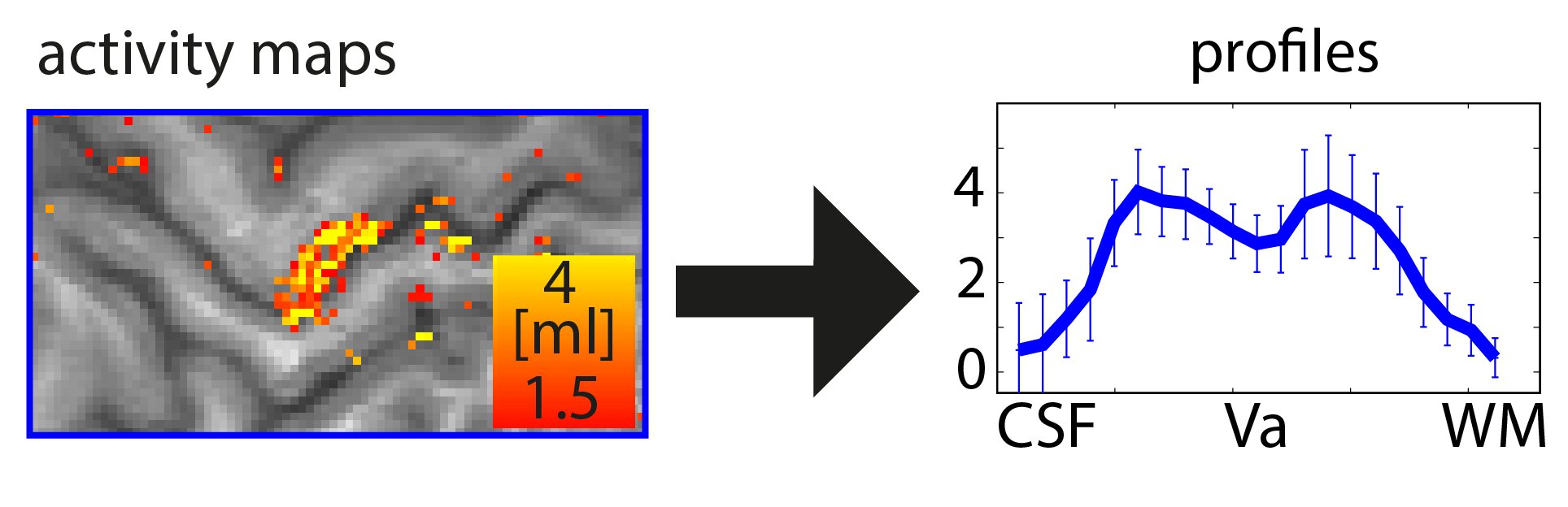
This is a step-by-step description on how to obtain layer profiles from any high-resolution fMRI dataset. It is based on manual delineated ROIs and does not require the tricky analysis steps including distortion correction, registration to whole brain “anatomical” datasets, or automatic tissue type segmentation. Hence this is a very quick way for a first glance of the freshly acquired data.

This post shows how you can get from activation maps to layer-profiles in 10 min. In a quick and dirty way.

The important steps are: 1.) Upscaling, 2.) Manual delineation of GM, 3.) Calculation of cortical depths in ROI, 4.) Extracting functional data based on calculated cortical depths.

Continue reading “Quick analysis pipeline of getting layer fMRI profiles without anatomical reference data”

Gradient Temperature

tSNR changes across time

I got interested in gradient temperature because of the weird effect that tSNR seemed to increase over time.

Upon posing this effect on Twitter, PracitalfMRI and Ben Poser suggested that it might be due to gradient temperature. So I learned how to track it with as described below.

Continue reading “Gradient Temperature”

GRAPPA kernel size

Almost every modern fMRI protocol (at SIEMENS scanners) uses GRAPPA. However, only very few people pay a lot of attention on optimal usage of the GRAPPA auto-callibration data. I realized the importance of optimizing GRAPPA parameters when doing high-resolution EPI. At high resolutions, GRAPPA-related noise can become an increasingly important limitation.  This is especially true with the low bandwidth that the body gradient coils force us to use.

In this blog-post I will explain how the GRAPPA kernel-size affects the fMRI data quality, how you can change it, how you can find out which kernel-size was used, and I will descrive simple software tools to identify regions that might benefit from adaptations of the GRAPPA-kernel size.

Continue reading “GRAPPA kernel size”

layer-fMRI software repositories

There is a long list of software packages that are capable of performing high-resolution MRI analysis.

Some of them are used by multiple groups and some of them are customized for specific studies only.

In this post, I want to give an overview over the most important software packages, their advantages and disadvantages, and their popularity in the field.

Continue reading “layer-fMRI software repositories”

Layer fMRI papers

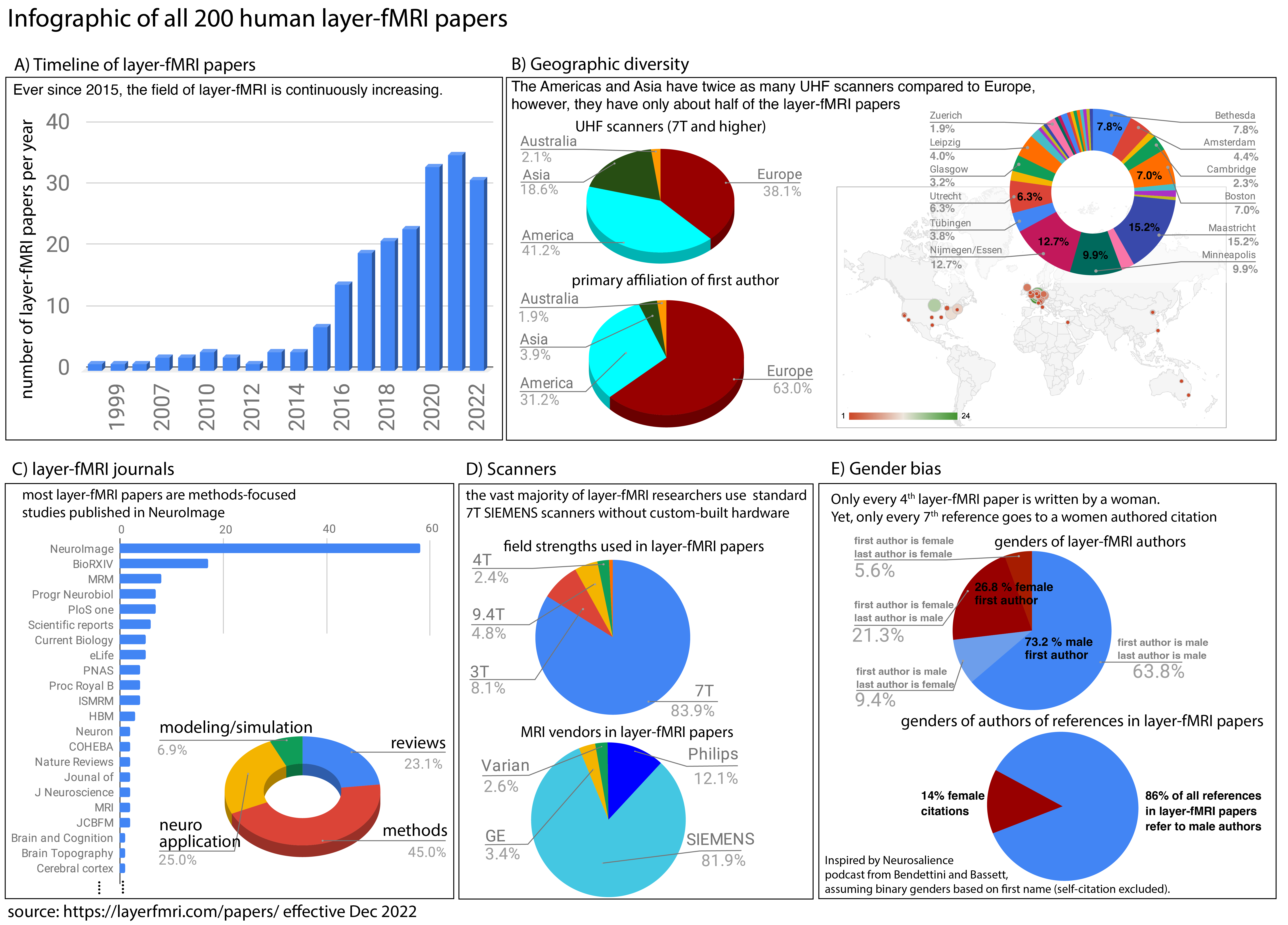
This page depicts a collection of all layer-fMRI papers.

This list solely includes papers that fulfill the following inclusion criteria:

  • focus on functional imaging
  • cortical layers (and/or sub-millimeter resolutions)
  • human imaging
  • preprints are included

Suggestions and corrections are welcome layerfMRI@gmail.com

For non-cortical, non-fMRI, non-human, or non-layer high resolution MRI, please see reviews in special issues 1, 2, 3 (and references therein). The raw data used in this infographic are available here.

Before and after COVID effects.

Click on image to enlarge.

Overview_book-01

2025

List is discontinued in April 2025. There are just too many papers. I am continuing to maintain the list on Gdrive. With the ambition to be comprehensive here.

2024

2023

2022

2021

2020

2019

2018

2017

2016


2015

2014

2013

2012

2011

2010

2009

2007

2002

1999