layer-fMRI abstracts

The following is a personal selection of my must-see layer-fMRI abstracts presented at SFN/OHBM/ISMRM. If I missed something, please let us know (layerfMRI@gmail.com).


SFN 2019 in Chicago

Saturday

  • 4:00 pm – 5:00 pm, 092.12/ BB63. Poster, O. STANLEY, Phase-based macrovascular filtering from gradient echo bold fMRI reduces orientation dependence.

Sunday

  • 8:00 am – 8:15 am, 111.01/Room S402. Nanosymposium talk, J. TOWNSEND: Non-invasive mapping of acoustic-phonetic speech features in human superior temporal gyrus using ultra-high field 7T fMRI.
  • 11:00 am – 12:00 am, 141.04/K28Poster, T. LIU: Affective processing of face stimuli in human primary visual cortex.

Continue reading “layer-fMRI abstracts”

MP2RAGE: challenges and artifacts of its use for layer-fMRI

The MP2RAGE sequence is very popular for 7T anatomical imaging and is very commonly used to acquire 0.7-1 mm resolution whole brain anatomical reference data. Aside of this common application, it can also be very helpful for layer-fMRI studies to obtain even higher resolution T1 maps in the range of 0.5mm iso. However, when optimizing MP2RAGE sequence parameters for layer-fMRI studies, there are a few things that might be helpful to keep in mind.

In this post, I would like to discuss the challenges of using the popular MP2RAGE sequence in layer-fMRI studies. Specifically I will discuss challenges/features regarding:

Continue reading “MP2RAGE: challenges and artifacts of its use for layer-fMRI”

Example analysis pipeline of layer-VASO

In this blog post I want to go through the analysis pipeline of layer-dependent VASO.

I will go through the all the analysis steps that need to be done to go from raw data from the scanner to final layer profiles. The entire thing will take about 30 min (10 min analysis and 20 min explaining and browsing through data).

During the entire analysis pipeline I am using the following software packages: SPM, AFNI, and LAYNII, and gnuplot (if you want fancier plotting tools)

Continue reading “Example analysis pipeline of layer-VASO”

How many layers should I extract?

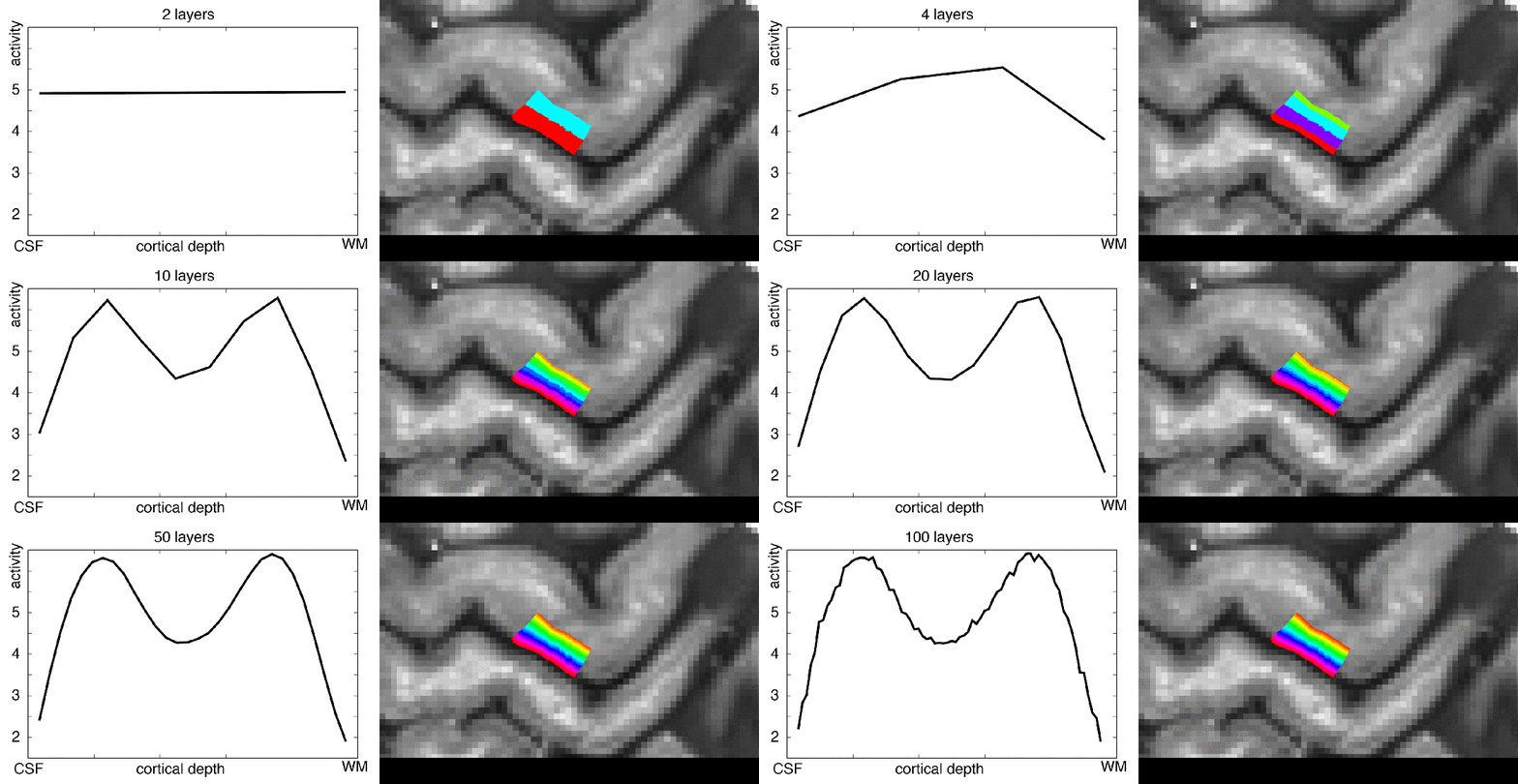
In this blog post, I want to share my thoughts on the number of layers that should be extracted from any given dataset. I will try to give an overview of how many layers are usually extracted in the field, I’ll describe my personal choices of layer numbers, and I will try to discuss the challenges of layer signal extraction along the way.

Continue reading “How many layers should I extract?”

‘layer fMRI’, ‘sub-millimeter fMRI’, ‘mesoscopic fMRI’, or ‘cortical depth dependent fMRI’…. Which term should I use?

What’s the best name of our field and what’s the best attributing term for our data? There are many competing options: “Layer fMRI”, “mesoscopic fMRI”, “sub-millimeter fMRI”, “ultra-high resolution fMRI”, “laminar fMRI”, “cortical depth-dependent fMRI”. They differ with respect to how flashy they are, how scientifically appropriate they are, and how popular they are.

In this blog post, I want to review which ones are the most popular ones in the field and also share some thoughts on my favourite candidates.

Edits on March 3rd 2019 with contributions and clarifications taken from Kamil Uludağ, Sri Kashyap and  Faruk Gulban.

Continue reading “‘layer fMRI’, ‘sub-millimeter fMRI’, ‘mesoscopic fMRI’, or ‘cortical depth dependent fMRI’…. Which term should I use?”

Registration of high-resolution data

In this blog post Sri Kashyap and I describe how to deal with the registration of high-resolution datasets across days, across different resolutions, and across different sequences.

I am particularly fond of the following two tools: Firstly, ITK-SNAP for visually-guided manual alignment and secondly, using ANTs programs: antsRegistration and antsApplyTransforms.

Continue reading “Registration of high-resolution data”

TR-FOCI pulse optimisations for SS-SI VASO

CBV-fMRI with VASO is highly dependent on a good inversion contrast. It gives it its CBV sensitivity and is also responsible for most of the VASO specific pitfalls (e.g. inflow, CSF etc. ). And thus, it should be optimized as much as possible.

In this blog post, I want to describe the most important features of a reliable inversion pulse for the application of VASO at 7T with a head transmit coil.

Continue reading “TR-FOCI pulse optimisations for SS-SI VASO”

Installing ISIS-conv on MAC

ISIS-conv is a very useful dicom to nii converter from Enrico Reimer. ISIS-conv gets along with a lot of challenging data sets that no other converter (that I know of) can handle so conveniently:

  • SMS-data, where individual slices have a non-constant inter-slice distances.
  • VASO data with non-constant TRs
  • Multi-echo, multi-coil, and Magnitude/Phase data.

There is a Mac-installation package of ISIS-conv. Unfortunately, however, with every IOS update, it has become more complicated to install it.

Since, I spend too much time figuring out how to install it after every update, I am collecting the necessary steps in this Blog post for future reference:

Continue reading “Installing ISIS-conv on MAC”

Anatomically informed spatial smoothing

In this blog post, I want to describe the application and working principle of a few spatial smoothing algorithms that are implemented in LAYNII.

  1. Confined smoothing along similar anatomical structures with LN_GRADSMOOTH
  2. Smoothing along the layers with LN_LAYERSMOOTH
  3. Smoothing within columns with LN_LAYERSMOOTH
  4. Smoothing across specific spatial dimensions only with LN_DIRECT_SMOOTH
  5. Smoothing long the time domain with LN_TEMPSMOOTH

Continue reading “Anatomically informed spatial smoothing”

Quick example of cortical unfolding in LAYNII

Update June 2021: There is a new and more comprehensive 3D-supported LayNii Program for cortical unfolding. Please see https://thingsonthings.org/ln2_multilaterate/

The blog post below is kept for archiving purposes: 

In this Blog post, I seek to describe a quick example of how to analyse high-resolution data across layers and columns with LAYNII.

Continue reading “Quick example of cortical unfolding in LAYNII”

Negative Voxels in VASO

In the last years, I and multiple other VASO users have encountered many occasions of voxels that show negative CBV change (positive VASO signal change) while the BOLD suggests that the activation should be positive. In this blog post, I want to list potential sources of this surprising effect.

Continue reading “Negative Voxels in VASO”

How send raw k-space data to any given server with Twix or with a modified ICE-chain

In this blog-post I want to describe a setup, how you can include an additional ICE functor in your reconstruction pipeline that sends raw Twix files from the Reconstruction computer to any given custom server.  Continue reading “How send raw k-space data to any given server with Twix or with a modified ICE-chain”

3D-printing nii data

In this blog post, I want to write about pipelines on how to prepare Nifti-brain data and make them printable by a 3D-printer.

Two pipelines are shown. One pipeline describes the 3D-printing the cortical folding structure that is estimated with Freesurfer and subsequently corrected with Meshlab. And another pipeline describes how you can 3D-print any binary nii-volume by using the AFNI-program IsoSurface and correct the output with netfabb.  Continue reading “3D-printing nii data”

How to convert any paper figure into a layer-profile

Often we would like to normalize depth-dependent fMRI signals and assign it to specific cytoarchitectonially defined cortical layers. However, we often only have access to cytoarchitectonial histology data in the form to figures in papers. But since we only have the web-view or the PDF available, we cannot easily extract those data as a layer-profile. Since most layering tools are designed for nii data only, paper figures (e.g. jpg or GNP) are not straight-forwardly transformed to layer profiles.

In this blob post, I describe a set of steps on how to convert any paper figure into a nii-file that allows the extraction of layer profiles.

Continue reading “How to convert any paper figure into a layer-profile”

2018 layer-fMRI meeting as part of the ISMRM study group ‘current issues in brain function’

Meeting minutes of Study group on brain functions business meeting:

15:30-16:30 in W07, June 21st, 2018, ISMRM, Paris:

Chunlei Liu presents the talk: “Ultra-high resolution fMRI – from hardware to pulse sequences to the human brain – and vice-versa. A 7T BRAIN Initiative Project” per pro David Feinberg.

In the subsequent Q/A period it is discussed that the current gradient design will be “asymmetric” and that the target parallel-imaging acceleration factor will be 20-30.

Past Chair Essa Yacoub presents the study group statistics:

There are many more trainees than full members.

Natalia Petridou presents the Trainee abstract awards:

  • #1 Adam Yamamoto for the abstract entitled: Intra-operative acquisition of sensorimotor fMRI during glioma resection: evaluation of feasibility and clinical applicability.
  • #2 Domenic Cerri for the abstract entitles: Mechanisms underlying negative fMRI response in the striatum. Since Dominic could not make it, he sent one of his collogues to receive the price for him.
  • #3 Yi-Tien Li for the abstract entitled: Inter-Regional BOLD Latency after Vascular Reactivity Calibration is Correlated to Reaction Time.

Renzo Huber presents the results of the survey among the study group members “Biggest challenges of high-resolution fMRI”. The slides can be downloaded here: https://doi.org/10.7490/f1000research.1115658.1

The attendees of the business meeting commented on the biggest challenges of high-resolution fMRI and the issues that could be discussed in a future virtual study group meeting.

·   Unknown (to me) senior study group member: At very high resolutions, the elastography of the brain might become a limit of submillimeter fMRI. This comment might be related to the Tweet from NIH Director Francis Collins that went viral on social media earlier that day: https://twitter.com/NIHDirector/status/1009793641550893056 (with amplified motion).

·   Ravi Menon: Motion is a big limitation of sub-millimeter fMRI.

·   Cheryl Olman: Every person/group uses a different analysis pipeline. It would be helpful to have a synthetic standard dataset that is open to everyone. Every person could play around with it and test the quality of various evaluation pipelines.

·   Hanzhang Lu: The virtual study group meeting would lose the interest of many study group members if the focus is only of 7T imaging. It would be helpful to also discuss the spatial specificity limitations at 3T too.

·   Shella Keilholz: Since there are so many trainee members, they should mention what they need.

·   Olivia Stanley (“encouraged” from Ravi Menon):

  1. Trainees want to know what segmentation tools are out there and how to use them.
  2. Trainees want more information on registration methods.
  3. Trainees would benefit from a tutorial on how to share code and how to use shared code.

·   Ravi Menon: So many people are sharing their code on various platforms. It would be helpful to have an online repository of repositories.

·   Essa Yacoub: It will be hard to standardize analysis pipelines because the data and the acquisition hardware is not standardized.

·   Trainee member (not known to me): The analysis of sub-millimeter fMRI takes a lot of computational recourses. Trainees can be limited by this.

·   Nikolaus Weiskopf: The image reconstruction can be a black box. It is not straight-forward to share pipelines of the Image reconstruction.

·   Nikolaus Weiskopf: Data-sharing becomes more difficult in the EU because of increasingly stricter privacy protection regulations.

·   Natalia Petridou: Data sharing is increasingly encouraged from the funding agencies and the journals.

·   James Pekar: The field of sub-millimeter fMRI stands on the shoulder of decades of preceding work from volunteers and people with passion. This study group can help todays volunteers and people with passion to increase their visibility.